Guidelines For Author
Guidelines for Submitting Scientific Articles to WJNAS
Section One: General Guidelines
- Scientific articles, as an original work, must have a research- basis and not have been published elsewhere.
- Scientific articles must be free of plagiarism.
- The style and writing of a scientific article must meet standards and be free of spelling and grammatical errors.
- In writing of scientific articles, primarily credible scientific sources should be used, and the number of sources used should not be less than 15.
- A scientific-research article must include sections such as: 1-Title, 2-Author details, 3-Abstract, 4-Keywords, 5-introduction, 6-research methodology (with subheadings such as the field of study, data collection methods, data analysis), 7-Results or research findings, 8-Discussion, 9-Conclusion & 10-Reference list.
- The abstract of the scientific article should be between 150 to 250 words and follow the sections: introduction of the topic, objective, research method, findings, and conclusion, all arranged in a single paragraph. Exceeding the specified abstract limit may result the article not being published.
- The font type for articles should be Times New Roman.
- The font size for the title of the article (12pt bold), main headings must also be (12pt bold), subheadings (12pt normal), and finally, the text size of the article should be 12pt normal.
- The font size of table and graph titles should be 2 sizes smaller than the main text of the article.
- The font size of the reference list should be 2 sizes smaller than the main text of the article.
- The font size of footnotes should be 2 sizes smaller than the main text of the article.
- APA citation style should be used for in-text citations and doing the reference list.
- Introduction for table/tables must be occurred at top section of the table/tables, while figures and graphs should be introduced below the figure/ graph, as per the guideline sample.
- Graphs and tables should be editable and correctable.
- All articles should be in Word format with a margin of (2.5) cm from all four sides.
Section Two: Initial Specifications
- The title of the article should be clear and explicit.
- Author details and addresses should be written below the title.
- The relevant organization, department, and university should be specified.
- The responsible author's email should be included.
- The corresponding author's contact number and email should be included.
Section Three: Structure and Sections of the Article
- The abstract should be between 150 to 250 words as mentioned earlier.
- Keywords should be alphabetically arranged, the same in content and meaning both in Arabic and English.
- The introduction should be clear (including the necessary introduction of the subject, detailed background/research context, and purpose of the current work).
- The method of the study should be prepared based on section one of the guidelines.
- Research findings should be included, possibly including figures and tables.
- Discussion (comparing your study with others and important comparative aspects with references, possibly including recommendations from the researcher).
- General conclusion (brief, in one paragraph, ranging from 100 to 200 words).
- Credible sources and references using APA style should be included, and their number should not be less than 15.
Note: The Systematic Review articles include the following sections:
Title, author introduction and address, abstract, keywords, introduction, methodology, comprehensive review of past research on a specific topic, thoroughly examined and summarized conclusions in a concise manner, up to a maximum of 200 words
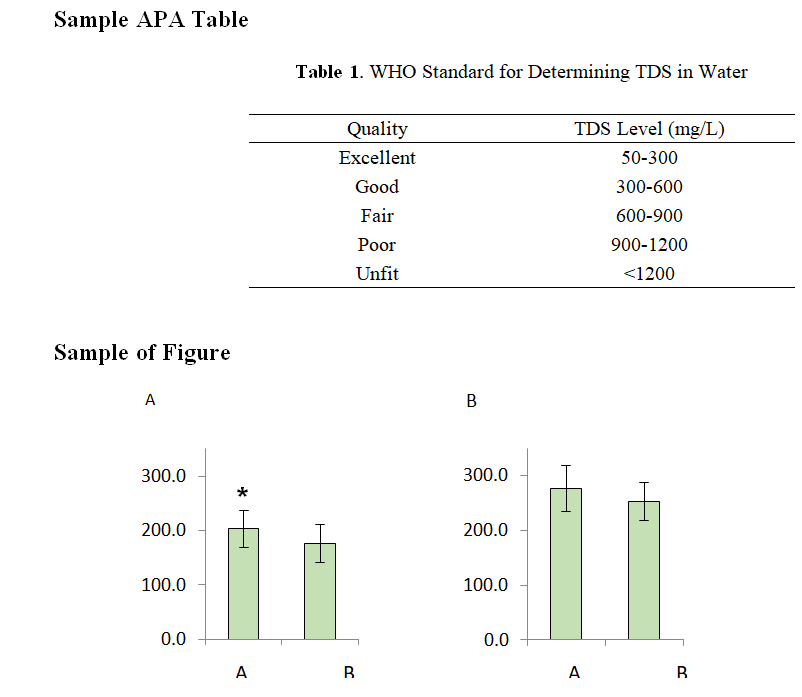
Figure 1. Average and standard deviation (SD) of Total Dissolved Solids (TDS) levels during the spring and summer seasons (A and B respectively).
Here's how you would reference in APA style
- Books: Author's Last Name, First Initial. (Year of Publication). Title of Book (Edition if applicable). Publisher's Name.
- Journal Articles: Author's Last Name, First Initial. (Year of Publication). Title of Article. Name of Journal, Volume Number(Issue Number), Page Numbers.
- Online Sources: Author's Last Name, First Initial. (Year of Publication). Title of Article or Source. Website Name. URL.
- Theses or Dissertations: Author's Last Name, First Initial. (Year of Publication). Title of Thesis or Dissertation (Doctoral dissertation or Master's thesis). University Name.
- Referencing a Section of a Book or Article: Author's Last Name, First Initial. (Year of Publication). Title
Examples
- Book: Smith, J. D. (2010). The Power of Habit. Random House.
- Journal Article: Johnson, A. B., & Williams, C. D. (2018). The Effects of Climate Change on Polar Bears. Environmental Science Journal, 15(3), 102-115.
- Online Source: Brown, K. M. (2015). The Impact of Social Media on Mental Health. Psych Central. URL: [website address].
- Thesis: Miller, R. L. (2019). The Role of Leadership in Organizational Change (Doctoral dissertation). University of California, Los Angeles.